

What role does generation–demand matching play in the success of energy cooperatives?
ENERGYTRANSFORMATIONRESENERGY COOPERATIVESENERGY COMMUNITY


A clearer understanding of the operational challenges faced by energy cooperatives requires revisiting the relationship between local energy generation and consumption. While most existing studies focus on the economic, environmental, and social benefits of cooperative models, this article takes a more technical perspective; namely, the optimal alignment between energy production and the actual demand of cooperative members.
In practice, cooperatives draw on a variety of renewable sources, including photovoltaic (PV) installations, wind turbines, biogas plants, and battery energy storage systems (BESS). When it comes to wind energy, household-scale turbines typically yield relatively low generation per installed kilowatt. As a result, PV installations remain a simpler and more widespread solution for cooperatives. Larger wind turbines are technically feasible, but their deployment is organizationally complex and capital intensive. For this reason, the analysis adopts photovoltaics as the primary generation source, taking into account the daily and seasonal variability of PV output as well as the diverse consumption profiles of end-users.
The following discussion is intended for illustrative purposes. Its aim is to highlight the planning challenges faced by energy cooperatives and to clarify how a mismatch between generation and demand affects system efficiency and increases the reliance on additional mechanisms such as net-metering or battery storage.
How does it work in practice?
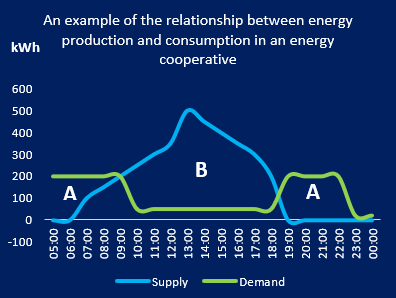
To illustrate how an energy cooperative operates from a technical perspective, it is useful to examine a representative daily profile of energy generation and consumption. The figure below presents hourly values for photovoltaic (PV) production alongside the corresponding demand of cooperative members:
When interpreting the data shown in the chart, two fundamental operational zones can be distinguished; both of which significantly influence the overall efficiency of a local energy community.
The first is the consumption surplus [Area “A”], typical of morning and evening hours in PV-based systems, characterized by demand outstripping generation. During these periods, the cooperative must purchase the energy deficit from the distribution system operator or retrieve it through the net-metering mechanism (which, in practice, also means drawing energy from the grid). This area clearly illustrates that a natural equilibrium between generation and consumption rarely exists and that maintaining operational harmony requires flexible solutions and continuous monitoring of energy use.
The second notable zone is overproduction [Area “B”], most common around midday, when PV installations generate more energy than consumers currently need. If battery storage is available, this surplus can be stored and used later, increasing self-consumption and reducing potential losses (especially relevant under net-metering, where exported energy is returned at a ratio from the virtual storage - grid-as-storage). Typically, 1:0.6 under the Polish net-metering scheme. In the absence of storage systems, however, the cooperative forfeits part of the potential generation; a classic and well-recognized challenge in planning community energy systems. Overproduction zones show clearly that generation alone does not guarantee full utilization. Crucial to this process is the intelligent, real-time matching of production to demand.
Considering these dynamics, it becomes evident that effective cooperative operation requires balancing the needs of both producers and consumers. Optimization goes far beyond simply maximizing generation; it also includes controlling energy flows, incorporating storage and compensation mechanisms, and minimizing reliance on grid imports. A solid understanding of these interdependencies not only reduces energy losses but also enhances the economic and environmental performance of the entire system; demonstrating how complex it truly is to plan for high self-consumption under real-world conditions.
Challenges in aligning photovoltaic production with consumption
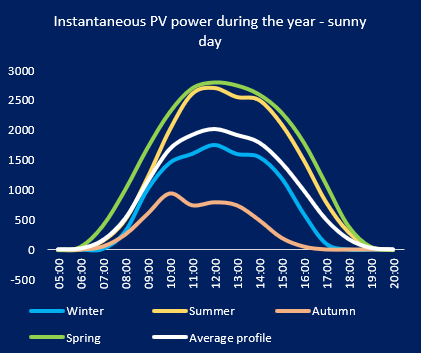
Analysing average PV generation profiles over the course of a year clearly shows that optimizing self-consumption within a cooperative is not straightforward. Energy production varies not only with the time of day but also across seasons and under different weather conditions. The figure below illustrates PV output for a typically sunny day, showing both seasonal variations and an averaged profile.
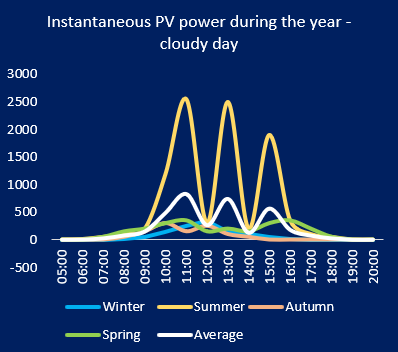
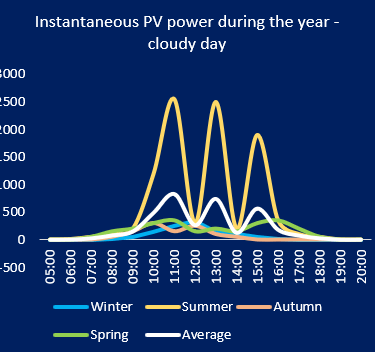
Sunny days are characterized by a pronounced midday “peak,” the height of which changes depending on the season. In contrast, cloudy days introduce much greater variability, with sudden dips and short-lived peaks, making production forecasting significantly more challenging. This variability and the substantial reduction in output during overcast periods are illustrated in the figure below.
Overlaying the averaged profiles of sunny and cloudy days in a single chart highlights the range of predictable production levels throughout the year. Operating within this range provides a general sense of generation dynamics over time but still does not guarantee full accuracy. Only by considering the real consumption profile do the challenges of matching generation to demand in real time become evident, underscoring the need for compensation mechanisms, energy storage, and flexible management strategies.
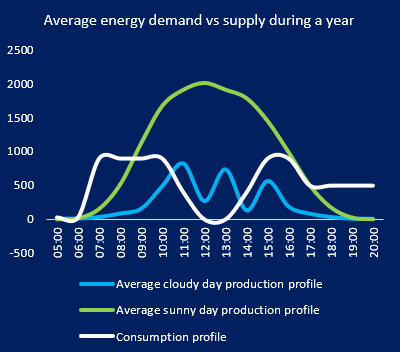
In the next step, the analysis compares the averaged PV production profiles with a sample consumption profile. This illustrative profile highlights typical challenges faced by energy cooperatives. For example, in the hours from 10:00 to 15:00, the examined facility is assumed to have suspended operations, which helps clearly demonstrate the difficulties in aligning production with consumption.
As the data show, in the morning hours (06:00–08:00) consumer demand exceeds PV production, necessitating energy imports from the grid or use of the net-metering mechanism. By 08:00 on sunny days, PV generation perfectly matches demand, achieving 100% self-consumption, whereas on cloudy days, grid reliance remains necessary. Around midday on sunny days, overproduction occurs, which can only be stored if a battery energy storage system (BESS) is available; otherwise, the excess energy is lost. On cloudy days, overproduction appears later; after 10:30 and surplus energy can be captured only after 14:00.
This example highlights that aligning production with consumption in a cooperative is far from being easy. Each installation behaves differently, as does the consumption profile of individual members. Therefore, proper planning, continuous monitoring, and flexible energy management are essential, especially under monthly billing cycles. Additionally, the existing self-consumption thresholds of 40% or 70% introduce further complexity when estimating real benefits. PV production depends on multiple factors, including system size and condition, weather, and daily and seasonal generation cycles, making even a simple example sufficient to illustrate the scale of the challenges in optimizing self-consumption in energy cooperatives.
Attempting to overlay the previously introduced Areas A and B on this example would produce a rather complex picture: overproduction and excess consumption intertwine dynamically throughout the day. The situation becomes even more complex when a cooperative operates multiple energy sources and members have distinct consumption profiles. It is also worth noting that settlement periods for cooperatives have recently shifted from full hours to 15-minute intervals, meaning energy balancing and accounting occur across four sub-periods per hour.
At this point, the system is no longer a simple puzzle; each additional element complicates self-consumption optimization. The picture becomes even more intricate when considering self-consumption thresholds, real-time monitoring of usage, and the potential of energy storage to curtail excess generation and retain it within the cooperative. Consequently, planning, managing, and settling energy in a cooperative requires meticulous preparation, flexibility, and continuous supervision—while also revealing how fascinating and multidimensional the real-world operation of energy communities truly is.
Summary – how to tackle the challenges of operating an energy cooperative
Solving the challenge of aligning generation with consumption in an energy cooperative is far from being straightforward. In practice, each cooperative has a unique energy balance. For instance, a municipality, a water utility, an industrial facility, or households will all behave differently. Every additional energy source or consumer introduces new variables that must be considered in daily planning. This challenge is particularly pronounced during morning and evening peak hours, when demand exceeds the instantaneous PV output, and around midday, when overproduction occurs. Without battery storage and proper planning, surplus energy is largely lost, reducing the overall system efficiency.
The situation is further complicated by variability in energy production due to weather and seasonal changes. Even on sunny days, output can differ by tens of percent depending on cloud cover, the angle of sunlight, or partial shading of the installation. Cloudy days add even greater unpredictability: early mornings and late evenings almost always require grid energy, while overproduction appears only around midday. Aligning production profiles with individual consumer demand therefore requires precise planning, continuous monitoring, and flexible energy management.
A key element in addressing these challenges is a well-chosen energy consultant who can comprehensively assess generation and demand profiles, recommend the optimal mix of energy sources, establish rules for energy settlement and profile alignment, and support the ongoing development of the cooperative by monitoring its day-to-day operation. With this support, it is possible to minimize the risks of overestimating or underestimating cooperative parameters while maximizing economic, environmental, and social benefits.
It is important to emphasize that the analyses and charts presented here are illustrative and intended solely to convey the basic relationships and challenges involved in matching generation to consumption in a cooperative. In practice, self-consumption planning requires an individualized approach, taking into account the unique profiles of consumers, the diversity of energy sources, and the specific characteristics of local infrastructure.
With these considerations in mind, we welcome collaboration in the implementation and optimization of such systems. We are fully prepared to assist with profitability analyses, system deployment, and effective cooperative management.
In the next and final installment of this series, the charts will be simplified and the text will take on a more narrative, essay-like style. It will be an opportunity to explore future scenarios for the cooperative energy sector in Poland, examining potential trends, innovations, and challenges for local energy communities. The aim will be to highlight both the potential and the limitations of citizen energy in practice, as well as to demonstrate how collaboration, planning, and the selection of appropriate tools can determine a cooperative’s success.
contact@edoadvisory.com


© 2026. Edo Advisory. All rights reserved.
Connecting ESG & Renewables